Tennis is one of the most widely played and most globally watched individual sports in the world — a game of extraordinary physical and mental demands that has produced some of the most celebrated and compelling athletes in sporting history. From the explosive power of a first serve that can exceed one hundred and forty miles per hour to the delicate touch required to redirect a ball cross-court from an impossible defensive position, tennis requires a combination of speed, strength, coordination, tactical intelligence, and mental resilience that few other sports can match in their totality. Whether approached as a recreational activity enjoyed on a local court on a Saturday morning or followed as a professional sport through the drama of Grand Slam tournaments watched by hundreds of millions around the world, tennis rewards both its players and its spectators with a richness of experience that deepens the more closely it is understood. This guide introduces the sport comprehensively — its fundamental mechanics, its scoring system, the equipment required to play it, and the legendary athletes who have shaped its history and its present.
The Basics of How Tennis Is Played
Tennis is played between two players in singles format or between two pairs of players in doubles format, on a rectangular court divided across the middle by a net. The objective is straightforward in concept and endlessly demanding in execution — use a racket to hit a felt-covered ball over the net and into the opponent’s half of the court in a way that the opponent cannot return effectively. Points are won when the ball bounces twice in the opponent’s court without being returned, when the opponent hits the ball into the net or outside the boundaries of the court, or when the opponent fails to complete a legal return within the rules of the game.
Each point begins with a serve — a stroke hit from behind the baseline into the diagonally opposite service box on the other side of the net. The server receives two attempts to land a legal serve. A first serve that lands outside the service box is called a fault, which grants the server a second serve. A second consecutive fault — a double fault — awards the point directly to the receiver. When a serve clips the net cord and lands in the correct service box, it is called a let, and the serve is replayed without penalty. Once the serve is successfully returned, the rally begins — both players trading shots until a point is decided.
The court itself is divided into distinct zones that become relevant in different shot situations. The service boxes are the areas near the net into which legal serves must land. The singles sidelines define the width of the court for singles play, while the doubles sidelines extend the court slightly wider for doubles matches. The baseline at each end is the boundary behind which players serve and to which they frequently retreat when defending. The no-man’s land area between the service line and the baseline is a zone that leaves players vulnerable to passing shots if they linger there too long — experienced players learn quickly to either advance all the way to the net or retreat fully to the baseline rather than camping in the middle ground between the two.
Understanding the Scoring System
Tennis has one of the most distinctive and widely misunderstood scoring systems in professional sport — a structure that builds points into games, games into sets, and sets into matches in a way that creates the remarkable characteristic that no lead is ever fully safe and no deficit is ever fully insurmountable until the very last point is played. Understanding this system is essential for following the sport with any genuine appreciation of what is happening strategically and emotionally at every stage of a match.
Points within a game are scored using a terminology unique to tennis. The first point won in a game takes the score to fifteen, the second to thirty, and the third to forty — a counting system believed to have historical roots in clock face notation used in early forms of the game. The fourth point wins the game outright, provided the winning player is ahead by two points. If both players reach forty each — a situation called deuce — one player must win two consecutive points to take the game. The first point after deuce gives that player advantage, and winning the next point from advantage wins the game. Losing the next point from advantage returns the score to deuce, and this cycle continues until one player achieves the two-point lead required to close the game.
Games are accumulated into sets, with most sets requiring a player to win six games while leading by at least two. If the set reaches six games each, a tiebreak is typically played — a first-to-seven-points format with a two-point lead required — to decide the set. Most professional matches are played as best of three sets, with the Grand Slam events for men using a best of five format that can produce the longest and most physically and psychologically grueling matches in the sport. This cumulative scoring structure means a player can win significantly more points than their opponent across an entire match and still lose — a mathematical reality that makes the ability to win the most important points, rather than simply the most points, one of the most critical competitive skills in tennis.
Tennis Equipment: What You Need and Why It Matters
The equipment required to play tennis is relatively straightforward in its basic form — a racket and a ball are the non-negotiable minimums — but the depth of variation within each equipment category, and the degree to which equipment choices can influence performance and comfort, makes understanding the options genuinely useful for anyone approaching the sport for the first time or seeking to develop their game beyond the beginner stage.
The tennis racket is the central piece of equipment and the one that carries the most meaningful variation in its characteristics. Modern rackets are constructed primarily from graphite or graphite composite materials that deliver an exceptional combination of lightweight construction and structural stiffness — properties that translate into faster swing speeds and more powerful ball striking than the wooden rackets used through most of the sport’s history. Head size is the characteristic that most directly affects playability for recreational players — a larger head size creates a bigger sweet spot, the central area of the string bed that produces the most power and control when the ball is struck there, making larger-headed rackets more forgiving of imprecise contact. String tension is a separate variable that affects the feel of the racket significantly — higher string tension produces more control at the cost of some power, while lower tension produces more power with some sacrifice in precision. Finding the right combination of these variables for an individual player’s physical profile, swing style, and experience level is the kind of equipment optimization that experienced coaches and specialist racket fitters help players achieve.
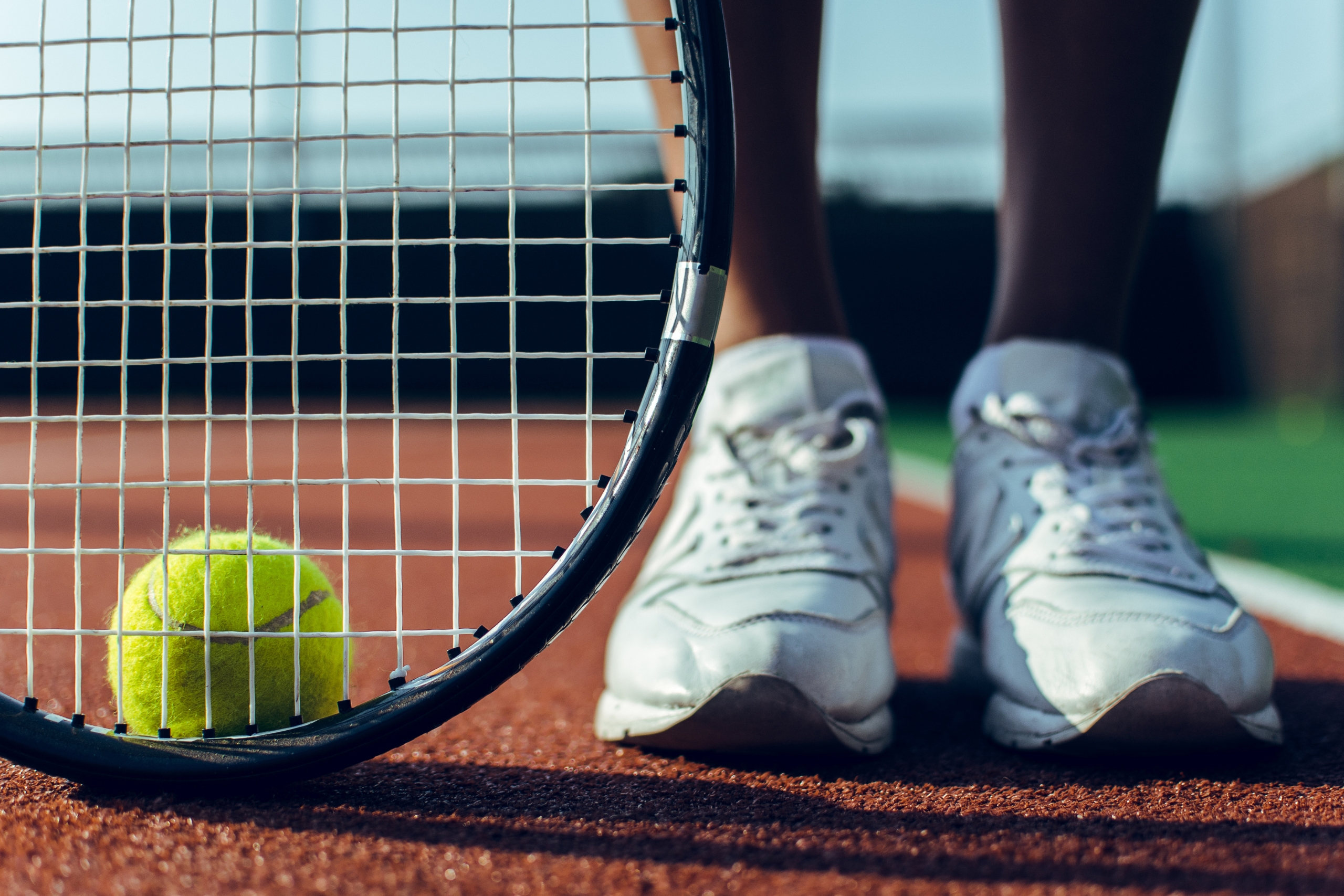
Tennis balls are manufactured in pressurized and pressureless varieties, with pressurized balls offering the livelier, bouncier response used in professional competition and pressureless balls providing a more consistent feel over extended periods of use that suits practice and recreational play. Court surfaces — hard courts such as the US Open and Australian Open, clay courts like Roland Garros, and grass courts like Wimbledon — use different ball specifications in professional competition to account for the different bounce characteristics and pace levels of each surface. Court shoes designed specifically for tennis are another equipment investment worth taking seriously — the lateral movement demands of the sport are significantly different from the forward motion of running, and shoes built for tennis provide the lateral support, non-slip sole grip, and toe protection that general sports shoes do not adequately deliver. Proper tennis footwear reduces injury risk meaningfully and makes confident movement around the court significantly more achievable for players at every level.
Core Mechanics and Shot Types Every Player Should Know
Tennis rewards technical refinement in its shot-making above almost every other physical attribute — and while the basics of hitting a ball over a net with a racket can be picked up quickly, the depth of technical skill involved in executing the sport’s core shots with genuine consistency and tactical effectiveness represents a craft that the greatest players in history have spent entire lifetimes developing. Understanding the main shot types and the mechanical principles behind them provides a clear map of what the learning journey in tennis involves.
The forehand groundstroke is the most frequently used and typically the most powerful shot in a recreational or professional tennis player’s arsenal. Hit from the dominant-hand side of the body after the ball has bounced, the forehand is typically the shot players develop their greatest confidence and aggression in — the one they seek to run around even from the backhand side of the court in order to create attacking opportunities. The two-handed backhand, dominant in the modern game at every level, provides additional power and stability from the non-dominant side of the body through the contribution of both arms to the swing — making it more reliable under pressure for many players than the one-handed backhand, which sacrifices some power and stability for greater reach and the capacity to generate more disguised slice shots. The serve is the one shot in tennis that a player executes entirely without the opponent’s involvement, making it the component of the game most directly amenable to technical improvement through solo practice — and the one where the gap between amateur and professional execution is most dramatically visible.
Volleys — shots hit from near the net before the ball bounces — require completely different mechanics from groundstrokes, demanding quick hands, precise racket positioning, and the aggressive forward movement and split-step footwork that allow a net-approaching player to cut off angles and apply pressure before the opponent has time to respond. The slice backhand — hit with a downward chopping motion that imparts backspin to the ball and produces a low, skidding bounce — is one of the most tactically versatile shots in tennis, used to change the pace of a rally, keep the ball low on grass and hard courts, and construct approach shot opportunities that set up a finishing volley at the net. Mastering the full range of these shots, understanding when and why each one is the correct tactical choice in a given situation, and developing the physical conditioning to execute them at full quality late in a demanding match are the interrelated challenges that make tennis one of the most deeply rewarding sports to pursue seriously over a lifetime.
The Greatest Players in Tennis History and the Sport’s Modern Stars
No introduction to tennis would be complete without acknowledging the extraordinary athletes who have defined the sport across its modern era — the players whose achievements, personalities, and competitive legacies have made tennis one of the most globally followed individual sports in the world. The depth of talent the sport has produced across the past three decades is genuinely remarkable, and the rivalries between its greatest champions have given the sport some of the most compelling competitive narratives in all of professional athletics.
Roger Federer is widely regarded as the most aesthetically complete player in the sport’s history — a player whose combination of natural movement, shot variety, technical elegance, and competitive longevity produced twenty Grand Slam singles titles across a career that spanned more than two decades at the highest level. Rafael Nadal’s fourteen French Open titles — an achievement so statistically improbable on any single surface that it defies reasonable historical comparison — and his twenty-two Grand Slam titles in total represent a record of sustained excellence on clay that the sport is unlikely to see equaled. Novak Djokovic’s extraordinary consistency across all surfaces, his unmatched record of twenty-four Grand Slam titles, and his ability to perform at the highest level well into his mid-thirties have established him as statistically the greatest men’s singles player the game has yet produced. The three-way rivalry between Federer, Nadal, and Djokovic dominated men’s tennis for nearly two decades and produced a body of head-to-head competition that elevated the standard of the entire sport.
In women’s tennis, Serena Williams stands alone as the defining figure of her era — twenty-three Grand Slam singles titles, sustained dominance across all surfaces, and a physical and competitive presence that transcended the sport and established her as one of the greatest athletes in any discipline of the twentieth and twenty-first centuries. Steffi Graf’s achievement of winning all four Grand Slam titles and the Olympic gold medal in the same calendar year — the Golden Slam of 1988 — remains one of the most extraordinary single-season accomplishments in tennis history. Among the current generation of players, Carlos Alcaraz and Jannik Sinner have established themselves as the dominant forces in men’s tennis following the retirement of Federer and the gradual transition from the Federer-Nadal-Djokovic era, while Iga Swiatek’s sustained world number one ranking and multiple Roland Garros titles have made her the standout figure in the women’s game. Within the broader world of sports and fitness, tennis occupies a uniquely prestigious position — a sport that demands and develops physical conditioning, strategic intelligence, and psychological resilience in equal measure, and that has produced a lineage of elite athletes whose achievements resonate far beyond the sport’s dedicated following.
Conclusion
Tennis is a sport of profound depth — accessible enough for a beginner to experience the joy of a clean strike within their first session, and demanding enough that the world’s greatest players spend their entire careers refining the smallest details of their technique, fitness, and competitive psychology. Understanding its mechanics, its scoring system, its equipment requirements, and the extraordinary athletes who have brought it to the global stage it occupies today transforms it from a game watched at a distance into one appreciated with genuine insight and informed enthusiasm. Whether picking up a racket for the very first time, looking to deepen an existing love of the sport, or simply seeking to understand what makes tennis one of the most enduring and compelling competitive spectacles in the world, the foundation laid in this guide offers a confident and complete starting point for a lifetime of enjoyment — on the court and off it.